

Shapes have edges. That’s the whole point of them.
An edge is a boundary — where one thing ends and another begins. A circle doesn’t bleed into the background. A triangle holds its corners. Even an organic shape, irregular and uneven, still has a line that says: this is where I stop.
That’s also what makes boundaries hard. They require you to declare an edge. To say out loud, or at least to yourself: this is where I stop.
With chronic illness, boundaries operate on two levels simultaneously. There are the ones we choose — pacing, saying no, keeping distance from people who cost us energy we don’t have, listening to our bodies when they say “I’m done.” And then there are the ones imposed on us: labels, assumptions, the invisible line a diagnosis draws around what other people think you’re capable of. Those boundaries didn’t ask our permission.
In this practice, we’re using shape to look at both kinds.
ENERGY RATING: 3
Shape, Form & Space
We’re exploring shape, form, and space across the next few practices as part of building our own visual language.
In art, these words have specific meanings. Shape is two-dimensional — it has height and width but no depth. It’s flat and defined by its outline. Shapes can be geometric (circle, square, triangle) — precise, nameable, mathematically describable. Or they can be organic (irregular, uneven, curved or angular), no official name but often suggestive of something.
Form is shape’s three-dimensional cousin — it has volume, depth, and weight. A circle drawn on paper is a shape. Add shading and a shadow and it becomes a sphere. Form can be literal (sculpture, clay, stuffed animals) or illusory (a drawing that creates the sense of three dimensions through light and shadow). Val Webb’s drawings are a great example here on Substack.
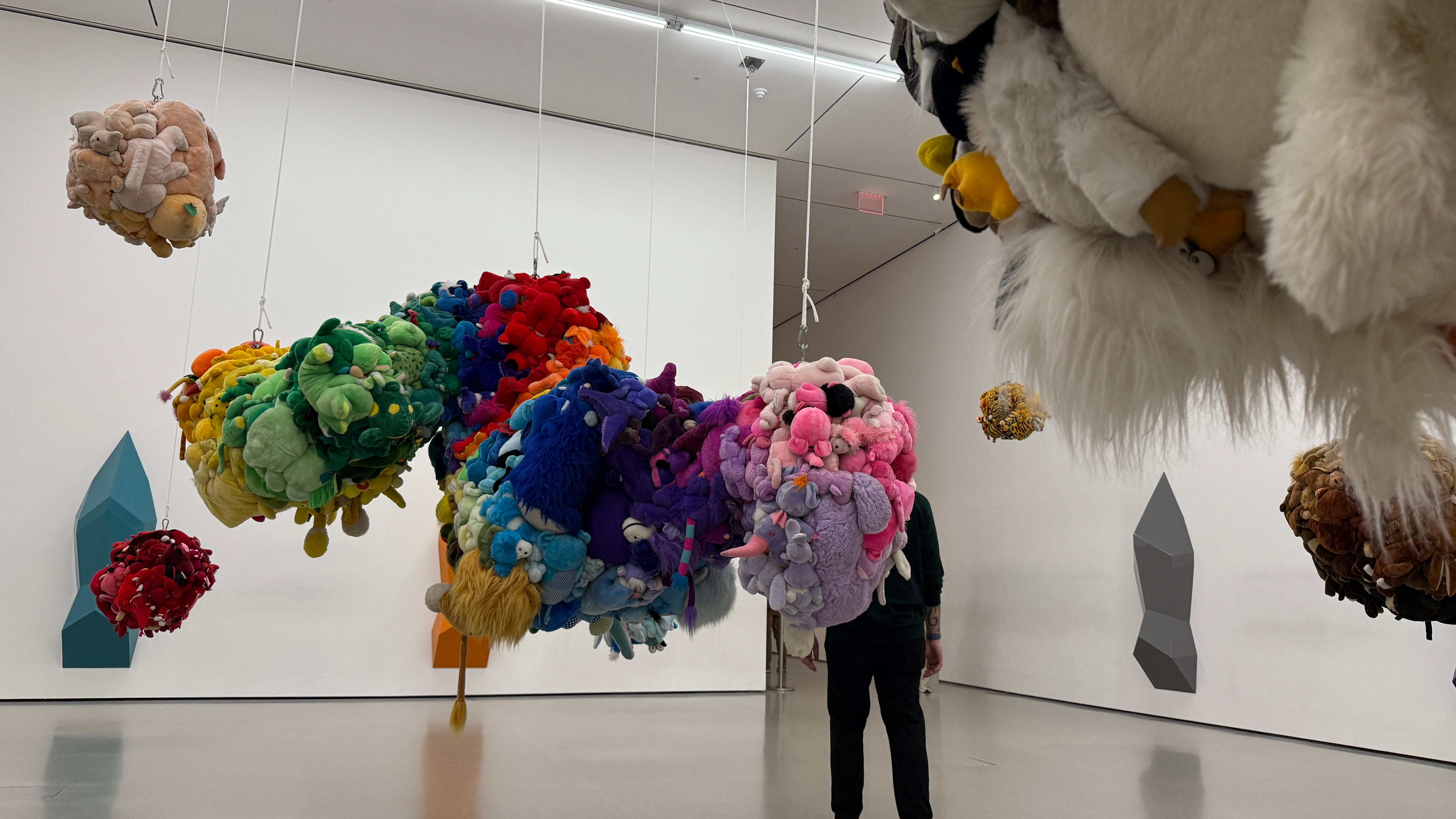
Space is the area within, around, and between shapes and forms. Positive space is what you made — the shape itself. Negative space is everything around it. Both matter. The relationship between them is where things get interesting.
Shapes create boundaries. And when two shapes meet, they create something new in the space between them — a secondary shape, an edge neither one planned. That’s the territory we’re working in today.
SUPPLIES
For the check-in, you will need:
Pencil
Marker, colored pencils or crayon (whatever you feel comfortable coloring with)
Paper: copy paper
For the practice, you will need:
Pencil
Colored paper: multicolored copy paper, old maps, magazines, construction paper, emotional paintings, old drawings or paintings, security envelopes
Scissors or exacto knife
Glue or glue stick
Sketchbook or art journal
If you need supplies, please consider purchasing from my affiliate links. I may earn a small commission from qualifying purchases (at no cost to you).
Blick Art Supplies
Collage: visit the list
Amazon List
THE PRACTICE
Check-in: Shape journal
Take a piece of copy paper and divide it into a grid — roughly 20 to 25 small boxes. Draw a shape in each box, whatever comes first, and color it in. Mix geometric and organic. Don’t deliberate. Let your hand lead.
This becomes the first page of your shape journal — a reference and starting point for your visual language. You can make more pages whenever you want, or carry a blank one with you through the day.
When you’re done, look at what you made. Notice which shapes you were drawn to. Whether one keeps repeating. Notice the shapes you colored — that’s positive space. Notice the white areas around and between them — that’s negative space. Those are your inside and outside boundaries, already there in what you made.
Sharing is spreading wellbeing for our community. I appreciate you sharing Crooked Path Studios on other social platforms.
Create
Pick two or three shapes from your journal that feel like they represent a boundary in your life. Maybe one you’ve chosen — something you hold to protect your energy or wellbeing. Maybe one that was placed on you, a label or assumption that doesn’t quite fit. Maybe one that’s medically imposed, something that shifts depending on what your body is doing that week.
Using your colored paper, draw these shapes in whatever sizes feel right. Cut them out.
Now you have two things: the shapes you cut, and the paper they came from. Both matter. The cut shapes are positive space — your declared boundaries. The holes left behind are negative space, the shape of what’s absent.
Arrange the cut shapes in your sketchbook. Overlap them or set them side by side. As you place them, notice what forms in the white areas between them. Those in-between zones — the spaces created by two boundaries meeting — are secondary shapes. They weren’t planned. They emerged from the relationship.
That space between two boundaries is its own territory. It has its own edges. And it’s worth looking at.
Notice the contrasts in what you’ve made. Some shapes may have sharp points or spikes — those might be the boundaries that cost you something to hold. Others may have rounder, more fluid edges. Some may have holes cut through them — a boundary within a boundary, layers you didn’t choose and can’t fully control.
Reflection
So let’s reflect on our shapes and our boundaries. Look at what you’ve made before you name it.
What boundaries do you want to hold — and which ones are you ready to push?
Which boundaries were placed on you by others, and how well do they actually fit?
What do you notice in the secondary shapes — the space that formed between your boundaries? What could happen in this space?
Conversation
I have colleagues who are genuinely good at setting hard boundaries. Clean edges, clear limits, no negotiation. I admire this. I have watched them do it for years and I still don’t fully understand how.
What I do know is that I don’t work that way — in life or in art.
I don’t start with shapes in my creative practice. I begin with color, gesture, torn paper, layers. Shapes emerge from that process — from blurring foreground and background, from what’s left when I step back. Or I add them at the end, after everything else has found its place. The one exception is my improv quilting, where I’m working with cut shapes from the start.


So when I set up this practice and started cutting shapes, I quickly became frustrated. More than I expected. It took me a while to understand why.
Cutting a shape forces you to commit to an edge before you know what you’re making. You decide where the boundary is before the work tells you. That’s not how I move through the world, and apparently, it’s not how I make art either. I come to edges from the inside out, not the outside in.
I took a few collage and Gelli printing classes over the past couple of years. All of them started with cutting shapes. All of them frustrated me in the same way, and I never quite figured out why until now.
The frustration is information. It’s telling me something about how I relate to defined edges — in my creative practice and probably elsewhere.
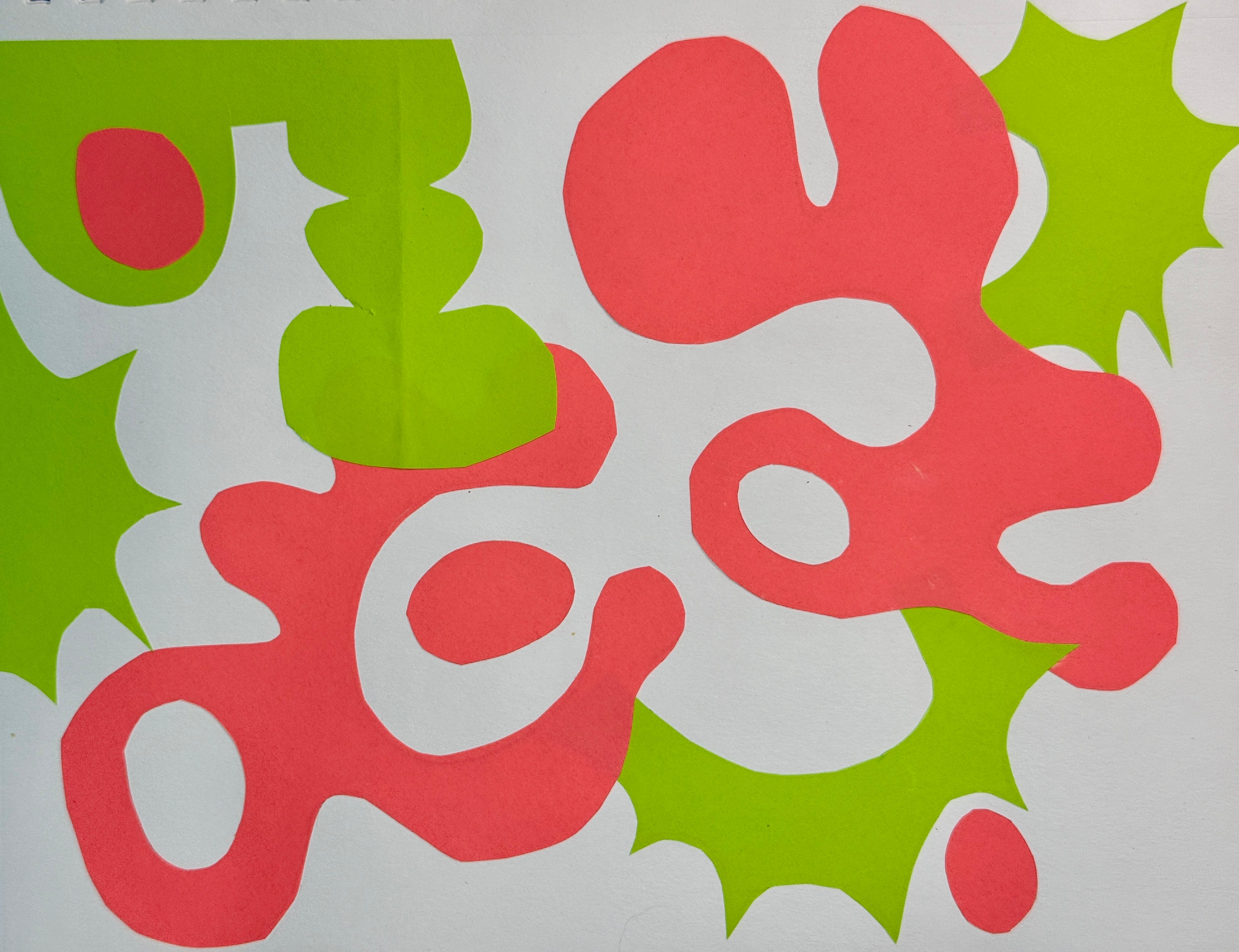
Now look at the finished collage. My intuition is still in this work, even though the process felt foreign. Those coral shapes are cut, but they move the way I move — loose, organic, reaching. The scissors followed something. And the white space isn’t neutral. It never was. The secondary shapes in the white — the zones between the coral and the green — are as visually active as the cut shapes themselves. That’s three layers of shape happening simultaneously: the green, the coral, and the white forms that appeared in the relationship between them. A few of the shapes from my library also have holes cut into them, including two of the coral pieces here. A boundary inside a boundary — a shape that declares its own interior edge. I tried adding slow drawing into the white space during the process. It flattened everything immediately. The white was already doing something, and the line competed with it rather than adding to it. That was its own piece of information: sometimes the space between boundaries is already full. You just can’t see it yet.
What surprised me more was what happened once I started placing the cut shapes on the page. The secondary shapes. The space created between two boundaries, the areas that weren’t part of either shape but were formed by both of them. That’s the part I couldn’t stop looking at — not the shapes I made, but the new edges that appeared in the relationships between them.
That’s where I want to keep working.
Check out
For our checkout, we are going to draw the shape our energy has today.
In your shape journal, find a blank box and draw the shape of your energy right now. Not a representational image — just the shape of it. In two dimensions.
Mine had a spiral shape.
Until Next Time
The next shapes practice is going to be different. I’m going to try to bring my way of starting — gesture, color, torn paper — into the same space as cut shapes and see what happens when those two approaches meet. Where are the edges you’re curious about pushing — in your practice or somewhere else? That’s where we’re going in our next shapes practice.
Keep on your crooked path
Crooked Path Studios is completely community supported. Here’s how you can be part of it.
Join Wayfinding — monthly open studios on Zoom, workshops, a private chat space, and members-only creative practices delivered to your inbox along with my monthly Life Lessons essays.
Go deeper — workshops à la carte and 1:1 therapeutic practice series are available through the shop.
There will always be a free Unfolding Path community with short therapeutic practices, studio reflections, and arts & health insights for women navigating chronic illness.
Because healing isn’t linear — and neither is art.


