

Last time, we cut out shapes and sat with them. Declared edges. Hard boundaries. And I told you it frustrated me — that cutting a shape before I know what I’m making isn’t how I work.
So, this time, I cheated. A little. On purpose.
I started with something familiar before I moved into something unfamiliar. I built a floor I could stand on before I pushed anything. And what happened when I layered the unfamiliar on top of the familiar turned out to be more interesting than either one alone.
That’s what this practice is about — not eliminating the boundary between comfort and discomfort but working right at the edge of it. The place where one thing bleeds into another and you get something new.
ENERGY RATING: 4
Shapes Part 2
If you’re just joining us, this is Part 2 of the Shape series. In the first practice, we made a shape journal and a simple collage to explore what boundaries look like visually — the shapes we hold, the ones imposed on us, and the secondary shapes that emerge in the space between two boundaries. This practice builds on that directly, so it’s worth watching or reading Part 1 first.
[ADD LINK TO SHAPES 1 — SUBSTACK AND YOUTUBE]
A note on composition
You may notice as you work with shapes and collage that you start making decisions beyond just what shapes to use — like where to place them, how they relate to each other, which ones come forward and which ones recede. That’s composition: the intentional arrangement of visual elements in space.
Composition is a full visual language element on its own and we’ll give it its own practice later. For now, think of it as the moment when you stop placing shapes randomly and start noticing relationships. When you move something because it feels wrong where it is. That instinct is composition. Follow it. It’s part of your visual language.
SUPPLIES
For the check-In
Pencil
Marker or crayon
Shape journal from Shapes 1, or a fresh piece of copy paper
For the creative practice
Pencil
Found paper in neutral colors that has a pattern or text on it: old maps, magazines, junk mail, the inside of security envelopes, old book pages
Colored paper: solid colored paper like construction paper or colored copy paper. You can also use any emotional paintings that you may have done. Any paper that is in contrast to the found paper you will use in the background.
Scissors or Xacto knife
Glue or glue stick
Sketchbook or art journal
If you need supplies, please consider purchasing from my affiliate links. I may earn a small commission from qualifying purchases (at no cost to you).
Blick Art Supplies
Collage: visit the list
THE PRACTICE
Check-in: Shape journal
Open your shape journal to a blank box — or draw one on copy paper.
Draw a shape that represents your most annoying symptom right now. Not a literal image of it. Just the shape it has in your body or your day. Don’t deliberate. Let your hand make the call.
If you’ve been around for a while, you know mine is brain fog, but that is followed closely by post exertion malaise or PEM. My PEM shape is a blob. If I were working in form instead of shape, that blob would be horizontal on a sofa. You know the one.
Create
Step 1: Build your floor
Draw a rectangle on your sketchbook page and mark the edges with painter’s tape if you have it. Working within a defined boundary — a frame — can make starting easier. It’s also a way of saying: this is where the work lives. Work small if your energy calls for it. A 5x7 space is plenty.
Using your found papers, collage a background that fills the rectangle. Tear or cut the papers and layer them until the background feels full. This doesn’t need to be precious. Think of it as putting together a puzzle made from torn paper — each piece with its own edges, its own text or pattern, its own weight.
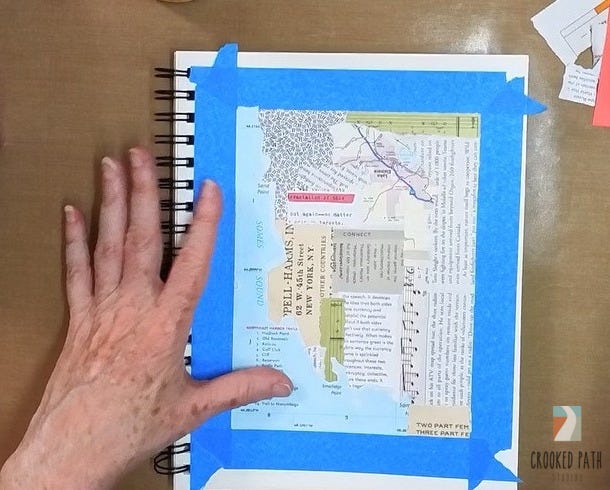
This is familiar territory for me. Ripping paper, building layers, responding to what’s already there. It’s where I start most of my work. And starting there made the next step possible.
Step 2: Audition your shapes
From your shape journal or colored paper, draw and cut out several shapes. Pull from the shapes you already know — the ones from your library — or make new ones. Cut the negative space too if it interests you; the hole left behind is its own shape.
Now lay your cut shapes onto the collaged background without gluing anything yet. Move them around. Let them overlap each other and the background. Slide them to the edges, into the center, on top of each other.
This is auditioning, not committing. You’re noticing relationships before you decide anything.
Step 3: Notice what’s happening
As you move shapes around, pay attention to a few things:
Where shapes overlap the background, boundaries blur — the edge of your cut shape is still there, but it’s in conversation with the text or pattern underneath. One boundary doesn’t erase the other. They negotiate.
Where shapes overlap each other, you get depth. Something comes forward, something recedes. A new boundary forms at the overlap — a secondary shape you didn’t cut, one that appeared in the relationship between two things you did.
Where shapes leave gaps between them, secondary shapes appear in the negative space. These are the in-between zones. The territory that nobody drew, that emerged anyway.
Respond to what you see. Cut more shapes if you need them. I went for a walk midway through and came back with shapes I’d borrowed from vines and moss. The practice doesn’t have to stay at the table.
Step 4: Compose and commit
When the arrangement starts to feel right — or at least interesting — glue things down. You don’t need resolution. You need enough to work with.
As you finalize placement, you’re making compositional decisions: which shapes come forward, which sink back, where the eye travels, what gets emphasized. Composition is just intentionality about relationships. You’ve been doing it already.
REFLECTION
Before you reflect, just look at what you made.
Which boundaries in your collage feel chosen — and which ones appeared without your planning them?
When two of your shapes overlap, what happens at the edge? Does one dominate, or do they negotiate?
With chronic illness, we often have to get comfortable operating at the edge of our capacity — not pushing past it, but not shrinking from it either. What did this practice tell you about where your edge is today?
What stories do you tell yourself that create boundaries you didn’t consciously choose?
Conversation
Here’s what I noticed: starting with the collaged background wasn’t cheating. It was scaffolding.
The familiar underneath made the unfamiliar on top possible. I wasn’t abandoning my way of working — I was using it as the floor I stood on while I tried something I wouldn’t normally do. That’s a different thing than starting from scratch and hoping for the best.
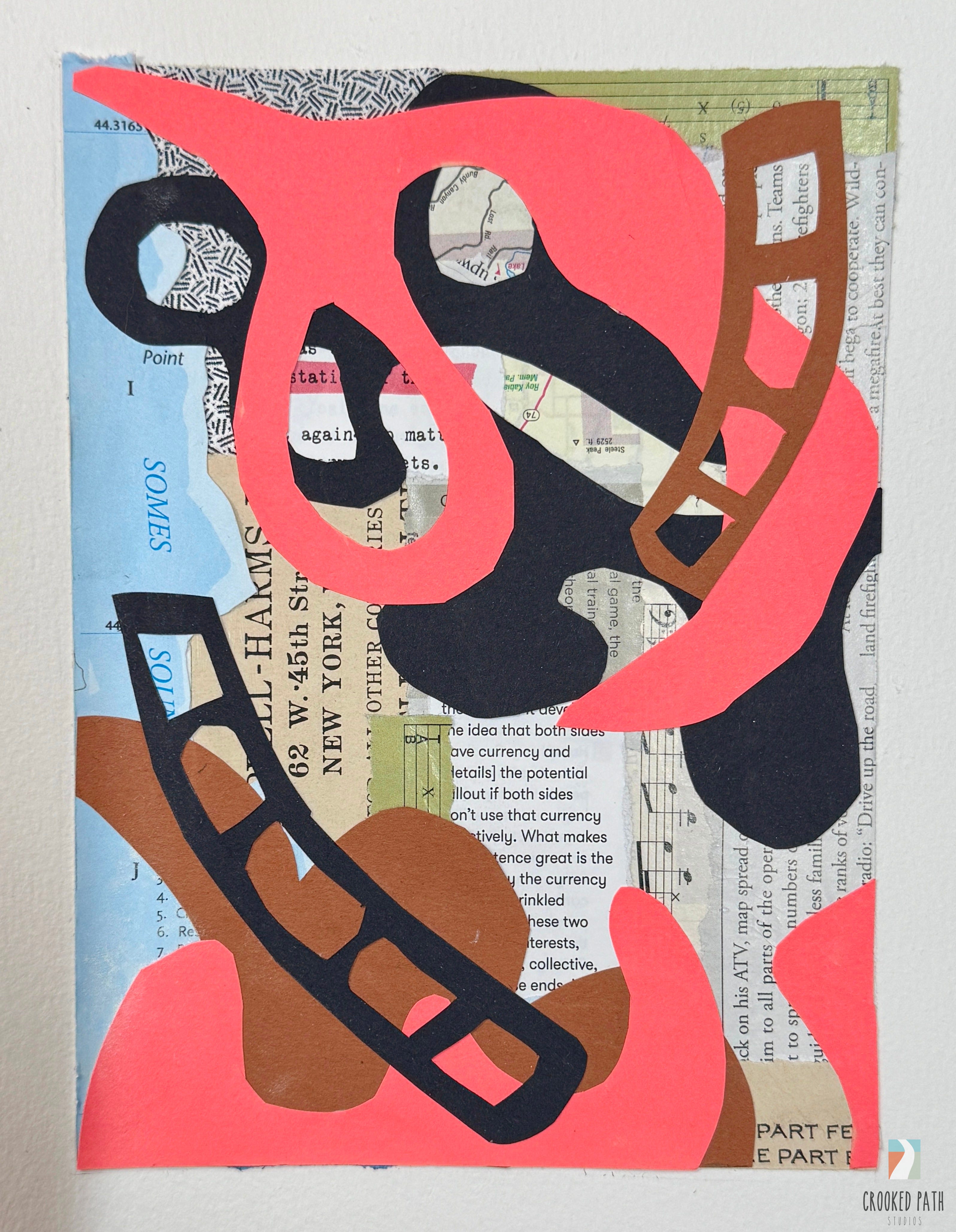
Once the shapes went down over the collaged background, something shifted. The cut shapes — with their declared edges — started blurring those edges the moment they landed on the layered paper beneath. The boundary of a shape is absolute when it’s sitting on white paper. Put it over a map fragment, patterned paper and a music score, and suddenly it’s in conversation with three other sets of edges simultaneously. It doesn’t disappear. It just gets more complicated.
And where shapes overlapped each other, something new appeared in that overlap. Not the first shape, not the second — the relationship between them. A secondary shape with its own boundary, one I didn’t draw or plan.
I kept thinking about the secondary shapes as the spaces where the rules haven’t been written yet. The places between established boundaries where there’s still room to maneuver. With chronic illness, so much of what we navigate is already bounded — by diagnosis, by capacity, by what other people think is possible for us. By what we think is possible for us. The secondary shapes are the spaces that aren’t claimed. Nobody’s labeled them yet.
The composition — where I placed things, what I let overlap, what I kept separate — was its own act of boundary-setting. Intentional this time. Chosen.
Check out
Add one more shape to your shape journal: the shape of your energy right now. Not representational. Just the shape it has.
Until Next Time
Next up in the Shape series: postcards. Cut shapes, small scale, something you can actually send someone. A different kind of boundary — the edge of a card, the distance between people.
Where are the edges you’re curious about pushing — in your practice or somewhere else?
Keep on your crooked path
Crooked Path Studios is completely community supported. Here’s how you can be part of it.
Join Wayfinding — monthly open studios on Zoom, workshops, a private chat space, and members-only creative practices delivered to your inbox along with my monthly Life Lessons essays.
Go deeper — workshops à la carte and 1:1 therapeutic practice series are available through the shop.
There will always be a free Unfolding Path community with short therapeutic practices like this, studio reflections, and arts & health insights for women navigating chronic illness.
Because healing isn’t linear — and neither is art.


