

The patterns from our last practice — wood grain, ribbon candy, effervescence —came from my body memory. For this practice, we’re going to continue building that kind of memory one line at a time.
Like last time, we’ll be drawing slowly. The slower you draw, the more information your hand gets and the more space opens up internally for everything else.
Today we’re getting our inspiration from Amy Maricle’s slow drawing practice, plus one I made up. Unlike the free motion drawings, these drawings are more contained. They are not designed to repeat across a surface but to stay in a small space.
What is Slow Drawing
This mindful drawing technique draws from the work of Amy Maricle of Mindful Art Studio, whose book Draw Yourself Calm and YouTube channel I’ve been working through to build my own sampler pages.
Slow drawing as a practice — drawing lines very slowly to create simplified, nature-inspired motifs — appears across multiple artists and traditions. Amy’s work is where I landed, and I keep coming back to it.
No surprise, I’m drawn to the more abstract motifs. But I learn something from each of them.
Like the free motion drawings, these translate well into altered books, art journals, collage, cards, and other mixed media work. This is one of the ways I’ve been extending my own visual language recently.
Supplies
For the Check-in and Practice:
A fine tipped pen or marker (for example .02, .03)
Paper: copy paper, cardstock, watercolor paper or a sketchbook
If you need supplies, please consider purchasing from one of my affiliate links. I may earn a small commission (at no cost to you) from qualifying purchases.
Blick Art Supplies
Mark Making: visit the Mark Making list and look for black pens like Sakura or Blick Studio Pigment Liners
Amazon
The Practice
Check-in
We’re going to draw our breathing today.
Square breathing has four steps: inhale, hold, exhale, and hold — each to a count of four. If you have lung complications from your chronic illness, hold each step for two counts instead. I worked my way up to four counts, and on a flare day I go back to two.
I invite you to practice the breathing once or twice before we add the drawing:
Inhale, 2, 3, 4
Hold, 2, 3, 4
Exhale, 2, 3, 4
Hold, 2, 3, 4
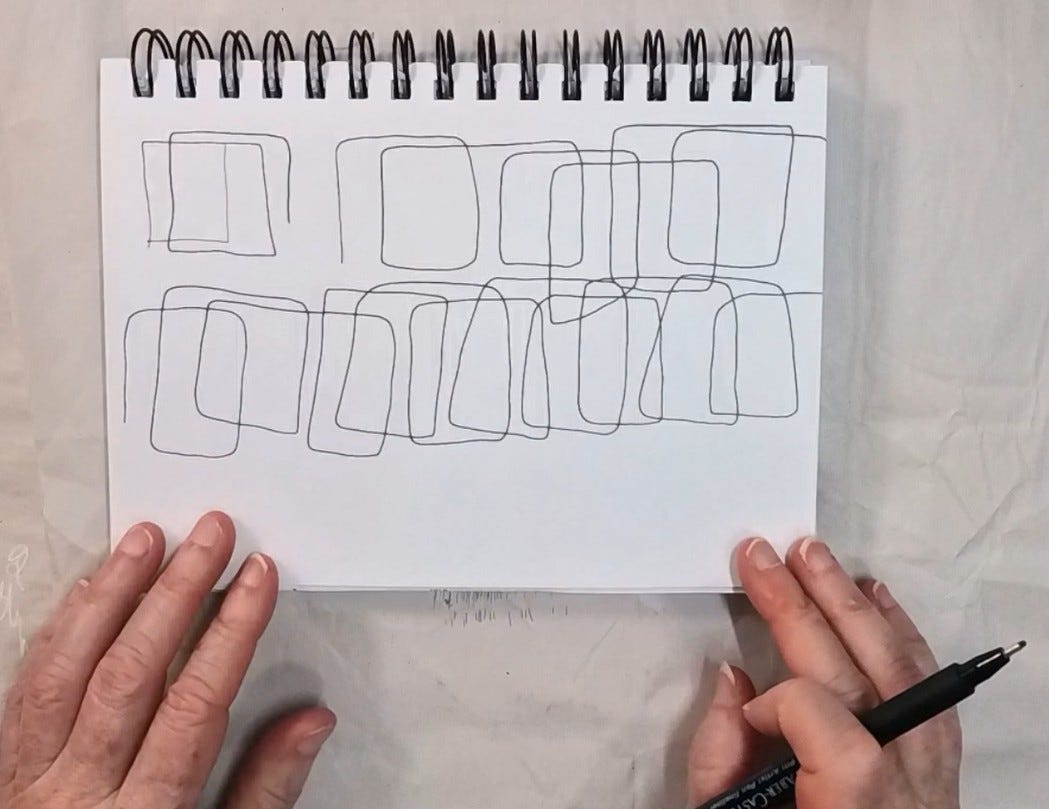
Now, using a marker and your paper, make a continuous line that mirrors your inhale, your hold, your exhale, and your hold. Keep your pen moving as you breathe.
Notice the lines you’re making and whether any patterns are forming. My overlapping lines created a secondary pattern that had a 1950s mod feeling to it.
Create
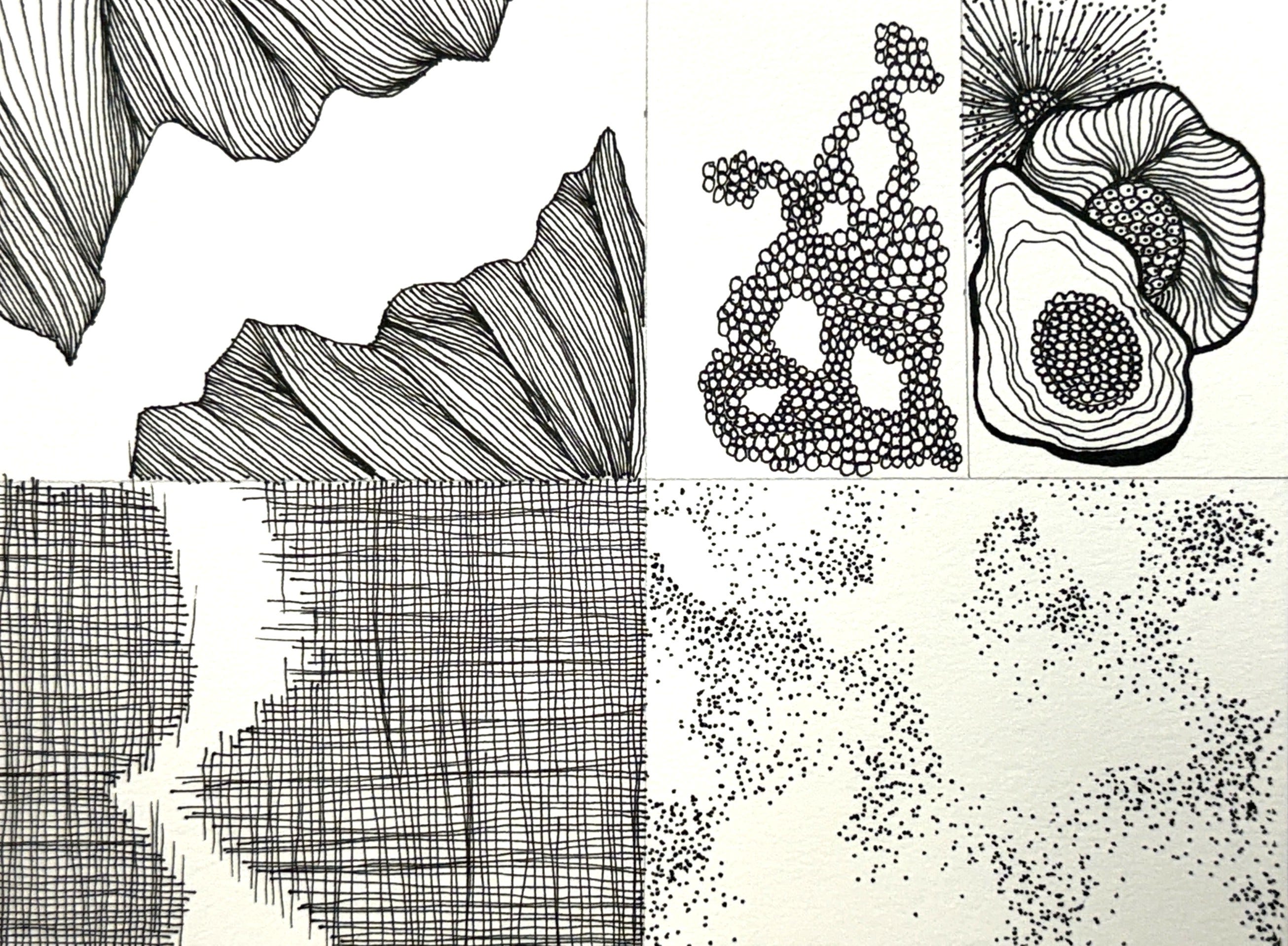
Today I’m demonstrating four motifs from Amy’s slow drawing practice plus one I made up. Because this is her work, I’m only doing four. If you like doing these kinds of drawings, I encourage you to visit her YouTube channel for more. She also offers a free class every Wednesday at 1pm ET.
To get started, divide your paper into 2x3” or 3x4” sections. Working small keeps these drawings manageable and makes them usable in other work.
All five motifs are built from the same basic marks: dots, circles, straight lines, curved lines. Once you know these, the patterns follow.
Dot
The dot is the most basic mark. It’s where a line begins. Dots draw and hold our attention and can be surprisingly powerful in a composition.
Begin by making some dots in your small square. Group some close together and others far apart.
Notice what happens when dots cluster densely in one area and then spread out.
See if you can create a shape or rhythm just by varying the density of the dots.
Whatever shape starts to emerge, go with it.
Cloth
This motif looks like a torn piece of cloth or mesh screen. Cloth has a warp and a weft— vertical and horizontal threads that create the weave. Look at your own clothes for a moment and notice the weave.
Decide where you want the tear or hole to be in your small square.
Draw the vertical lines of the weave first, stopping where the tear or hole will be in your cloth.
When you are done with the vertical lines, turn your paper or sketchbook 90 degrees.
Begin to draw the horizontal lines (they will be vertical now; it is easier to draw vertical lines that horizontal).
Edge
Edge is one of the most dramatic and most straightforward of the motifs. You’re echoing a line and letting it follow its own curve, which creates depth, space, and texture.
Draw a jagged line diagonally across one of your small squares. It should have peaks and valleys.
From each valley, draw a line down to the edge of the square. These lines should not converge in one spot. We are dividing up the drawing into its natural shape.
Starting at any of those lines, draw another line next to that one.
Keep echoing these lines as you make your way to the next valley and another line.
Follow any natural curves that happen. It’s OK if some of the lines go over top of each other. It will create a natural fold like in fabric.
Nook
This is a cluster of circles that expands outward with gaps or empty spaces — almost like foam or bubbles.
Start by drawing a small circle.
Then draw several more clustered around that first one.
Keep expanding your circle mass.
To create a hole or empty space in your circle mass, draw your circles around the shape you want to leave empty. It doesn’t have to be a circle; it could be an organic shape.
You don’t have to fill the entire small square. Your circle mass can be small or only take up a part of the square.
Create Your Own
Combine different lines from these motifs or the Free Motion Drawing from May to create your own design. Break your idea into the basic lines: circles, dots, straight or wavy lines.
If you’re looking for some inspiration, you can check out my Slow Drawing Pinterest board for more motifs.
Technical Note
We started with line, but we didn’t stop there. As lines accumulate, they begin to converge, cross, echo, soften, repeat—and suddenly we’re no longer just drawing lines. We’re working with texture, pattern, repetition, and rhythm. And creating shapes.
These aren’t just formal design concepts. They are also somatic cues for the nervous system to recognize safety, stimulation, predictability, novelty, and flow.
Texture: refers to the surface quality of the mark, paint, or other media, such as density, layered, soft, gritty. But texture is also how these marks feel in the body while making them and when looking at them. Our brains map visual texture onto tactile memory.
Pattern: Pattern is an organized repetition of visual elements—lines, shapes, marks, or textures—that creates structure and continuity. Patterns can be regular and predictable or irregular and evolving. Pattern helps us orient through predictability or notice when that predictability changes to uncertainty.
Repetition: when an element—line, shape, gesture, or mark—is used again and again. It’s one of the primary ways an image builds coherence and emphasis. But it is also a way to soothe and regulate, and allow sensations and meaning to unfold over time.
Rhythm: Rhythm is the sense of movement created by repeated elements with variation—changes in spacing, direction, pressure, or intensity. Rhythm guides the eye the way a beat guides music. Visually, it guides the eye. Somatically, it reflects pace, breath, and the body’s sense of flow or strain.
Shape: refers to two-dimensional art specifically and emerges when lines enclose space. Visually, it creates form and boundary. Somatically, shape relates to containment—how the body senses edges, support, and where one thing ends and another begins.
A visual language is, at its core, a conversation between your hand, your eye, and your body.
Reflection
Let’s take a step back from our work and reflect on the process.
Which pattern held your attention? The one where you lost track of time.
Losing track of time means you’re in flow — and that’s where the processing happens: memories, experiences, identity.
What memories or ideas came up for you while you were drawing? How did drawing help you connect memories, ideas, and maybe a new sense of self?
How might slow drawing be helpful during the day? Maybe a waiting room, a long afternoon at work, or a flare?
Conversation
Flow is a state of complete absorption. The psychological researcher Mihály Csíkszentmihályi spent decades studying it, beginning with painters who forgot to eat while they worked. In flow, time disappears, self-consciousness drops, and action and awareness merge. The hand moves intuitively or from memory without waiting for the brain to direct it. The default mode network (DMN) — the part of the brain that processes memory, meaning, and identity — activates. You’re not thinking. You’re making, and the making is doing something else underneath.
Slow drawing opens that door. What walks through isn’t sorted by category or weight.
During filming, two memories walked through for me. One was from the early days after my diagnosis — new challenges I hadn’t anticipated, and the friends who showed up not with casseroles but with legal strategy and transportation. The second was a foster dog, a misread cat, and a screened porch that didn’t survive the misunderstanding. One memory carried grief and gratitude in the same breath. The other made me laugh out loud in an empty studio.
Flow doesn’t sort memories or identities.
What I didn’t share in the video is why I started fostering animals in the first place. In 2024 I began working with Green Dogs Unleashed a rescue that specializes in special needs animals — blind, deaf, medically complex, traumatized, shut down. I work mostly with the traumatized and shut down ones. The ones that arrive frozen, unable to move or look you in the eye. Their world is very small because, to them, the world is not safe.
Chronic illness has a way of shrinking your world too. Not always dramatically — sometimes just incrementally, one cancelled plan at a time, until you look up and realize your local connections have quietly thinned. Fostering was a deliberate choice about what kind of life I was going to build with this changed body. Something that fit within my capacity.
You can’t rush a shutdown animal. You sit with them. They set the pace. And I know a thing or two about pacing. You wait for the moment they come to you, walking across the room, pushing their head into your hand, asking to be petted. And then their personality starts to come out. You see their joyful, loving self as their world gets bigger.
I recognize that negotiation.
Check out
As we did with the Free Motion Drawing, I invite you to add these motifs to the hand drawing we started in the last practice. If you finished that or didn’t start that drawing, trace your other hand and use these motifs.
Take it with you. A sketchbook and a pen go anywhere.
Until Next Time
Slow drawing is one way to build your visual language — through repetition, body memory, and letting the hand lead. Through flow state. The motifs are simple. What surfaces while you draw them is not always.
If you’re part of the Crooked Path Studios community on Substack, I invite you to share your work in the chat. It’s a reflective sharing space — we recognize each other and our creative practices here, not a critique space. We create in community because that’s one way to push back against the isolation that chronic illness builds around us.
If you’re not yet part of the community, come find us.
Until next time, stay on your crooked path
Crooked Path Studios is completely community supported. Here’s how you be part of it.
Go Deeper
Book a 1:1 creative practice series for more contained support. You can also visit the shop to find the Low Histamine Compass or donate to keep some of the practices free.
Join Wayfinding
Monthly open studios on Zoom, live virtual and pre-recorded workshops and archives, a private chat space, and creative practices like this delivered to your inbox along with my monthly Life Lessons essays and members-only practices.
There will always be a free Unfolding Path tier with short therapeutic practices, studio reflections, and arts & health insights for women navigating chronic illness.
Because healing isn’t linear — and neither is art.


