

The first time I used a Gelli plate, I was so excited to print again. I had forgotten how much I loved printmaking when I was an art student in college.
But I also forgot I had MCAS now, and one of my main triggers is dyes—like pigments in paint.
Lesson Learned
I started Crooked Path Studios so those of us navigating rare chronic illness and their caregivers could develop a creative practice in a space that fit our needs.
And that includes using safe art materials and taking precautions for our chemical sensitivities. Which is what I didn’t do on that first day of Gelli printing.
At the time, I was working on a community-based arts and health project with a group of art therapists, and they introduced me to Gelli plates. I immediately ordered one from Amazon.
When the Gelli plate arrived, I was so excited. I set aside an entire Saturday giving myself plenty of time to set up and not expend all my energy in one day.
I dove in with both hands—literally. No gloves, just pure joy.
For a few hours, I felt like myself again. I was in flow—a concept developed by Csikszentmihalyi (chick-saint-me-high) to describe what happens when we get into the meditative creative state, and focused on the present moment:
Time slowed down
I was focused on the process not the product
It was just enough of a challenge to stretch my skills but still feel familiar
I was learning new things, taking risks, saying “What if?” and experimenting
My actions, movements, and thoughts were like music responding to changes on the Gelli plate
I had more energy than I had experienced in a few years.
(Read more about Csikszentmihalyi’s theory and the optimal conditions for entering a flow state here and here).


I was so focused on the process, I totally forgot that one of my biggest MCAS triggers is dyes and chemicals like you find in acrylic paint and slo-dry extender (which I used to keep the paint from drying too quickly).
The next day started with serious brain fog and got worse from there.
Had I eaten a high histamine food?
—No.
Had I been in the sun?
—Nope.
Then I realized I had printed with bare hands and washed the brushes with bare hands, getting paint on my skin.
The flare lasted a few days. But the joy of creating lasted much longer. And I realized I needed not just safer art supplies but better protocols to handle all art supplies.
History of Toxic Art Supplies
For centuries, artists have pursued vivid, lasting pigments often at great personal risk. Lead white, one of the earliest synthetic pigments, was widely used from ancient Greece through the 19th century for its brilliant opacity, despite its severe toxicity. Known to cause “painter’s colic,” or lead poisoning, it was absorbed through the skin or inhaled as dust when making the paints (paints in a tube began in 1841). Or the lead was ingested sometimes even from licking brushes. Artists like Vincent van Gogh and Francisco Goya are believed to have suffered neurological and psychological symptoms linked to chronic lead exposure (Art Is Beautiful. It Could Also Kill You. Here Are 7 Deadly Art Materials to Watch Out For; Cleveland Clinic).
Similarly, cadmium-based pigments, introduced in the 1800s, offered intense reds and yellows but posed risks of kidney damage and lung disease when inhaled as dust or fumes. Arsenic-laced greens like Scheele’s Green and Paris Green were used in paints, wallpapers, and textiles, and are now known to be highly toxic, capable of releasing poisonous vapors (VOCs) and causing illness or death through skin contact or inhalation (CAMEO, Museum of Fine Arts Boston).
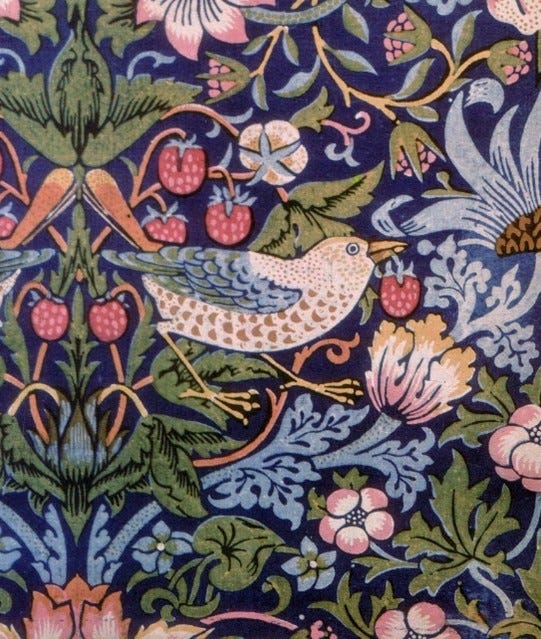
“The Strawberry Thief,” 1883, by William Morris. Morris’s family owned an arsenic mine and his wallpapers were infused with the chemical to create the bright Scheele’s green colors (Photo from Art is Beautiful article; by Art Media/Print Collector/Getty Images)
Printmakers and painters alike faced additional hazards from solvents and powdered pigments. Turpentine and benzene—common in today’s paint thinners and cleaning agents—were often used in poorly ventilated studios, leading to respiratory issues, neurological damage, and increased cancer risk. Benzene, in particular, is now classified as a known human carcinogen linked to leukemia and other blood cancers (American Cancer Society).
Dry pigments, when ground or mixed, created airborne dust that could be inhaled or absorbed through the skin, compounding the danger. Despite early warnings from physicians like Bernardino Ramazzini in the 18th century, it wasn’t until the late 20th century that widespread regulation and safer alternatives began to emerge. Today, many traditional pigments have been reformulated or replaced, but those of us with chemical sensitivities must take extra precautions.
A Guide to Today’s Nontoxic Alternatives
Making art and creativity are embodied, somatic experiences. We use our whole bodies and all parts of our brain when we create. Being able to feel the different media and surfaces as you make marks or brush strokes, and being able to move in certain ways is important to the experience.
But for those of us with chronic illnesses, like MCAS, that make us sensitive to smells, chemicals, pigments and even friction or vigorous movement, the arts can be a minefield of triggers. The materials we use and how we use them in our creative practice matter.


I figured out how I could continue my new creative practice in a safe way and still make it an embodied practice. I’ve put together a Safe Art Supplies Guide outlining the toxic art ingredients to avoid, especially for chemically sensitive bodies like ours.
But more importantly, I’ve also included a list of safer alternatives and simple ways to protect yourself. For me that means wearing gloves. I can still smear things, but it doesn’t cause a flare up the next day. I also avoid anything with Cadmium (like cadmium red or yellow), Titanium (like titanium white), or other metals as ingredients.
You can download the Safe Art Supplies Guide after subscribing. The Guide includes links to products. At this time, I am not an affiliate for these companies, and I have noted which art supplies I tend to use.
Start Your Crooked Path
if you’re ready to reclaim or start your creative space, join the Crooked Path Studios Substack community for women with rare chronic illnesses, including chemical sensitivities.
Get access to a supportive creative space designed for us and begin your nonlinear path to wellbeing. You don’t have to be an artist or consider yourself creative to play here, you just need to be curious.
And if you’ve found safe art supplies that aren’t on the list, please share and I’ll update the list.
Thanks for reading Crooked Path Studios! If you know someone who would enjoy or benefit from a creative practice, please share Crooked Path Studios with them.
References
[1] theartbog.com
[4] www.jstor.org


