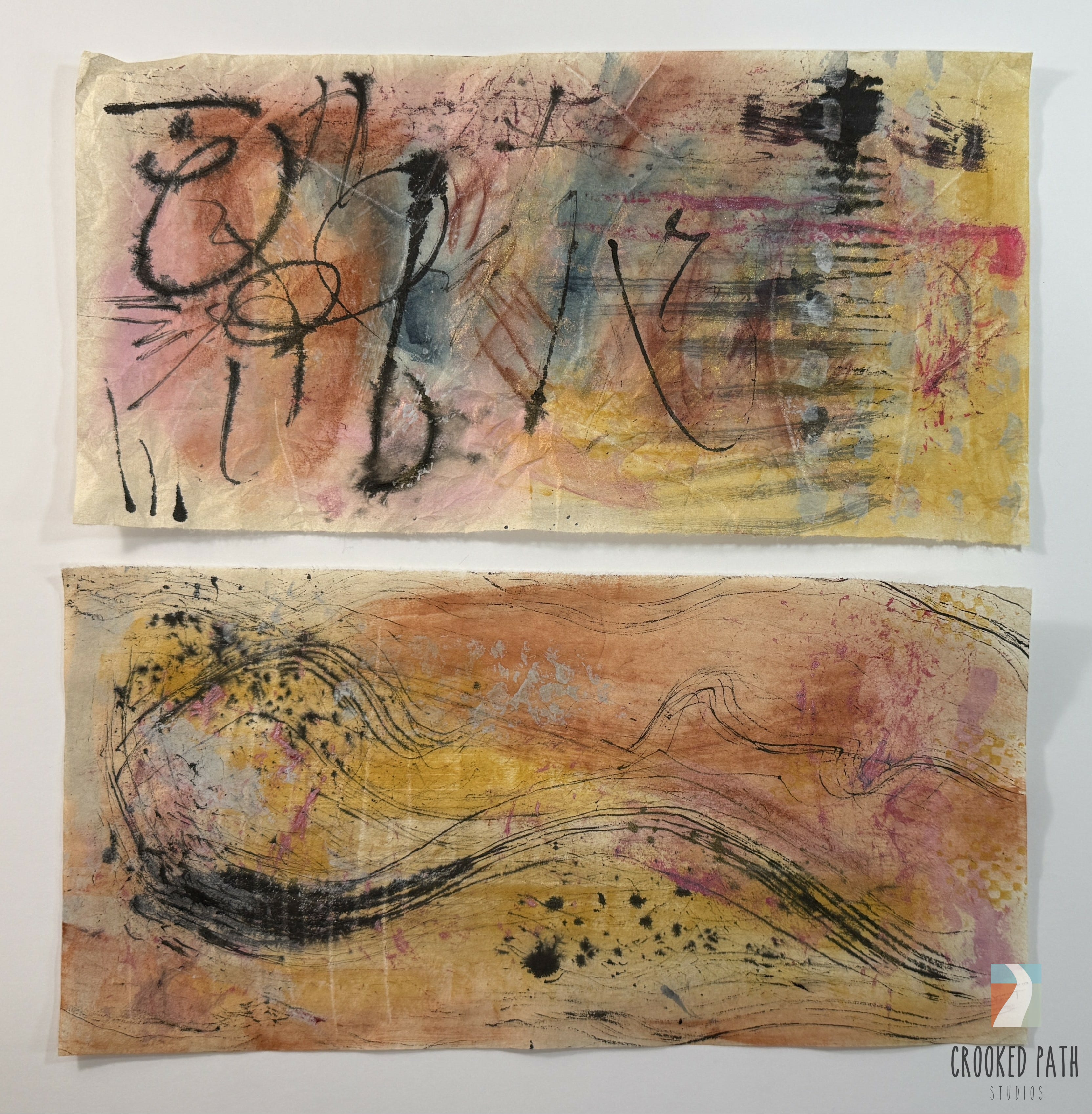
A friend highly recommended it, swearing it creates beautiful translucent layers in collage. So, I sat down with my paints, sponge brushes loaded with coffee and other mark making tools expecting the liquid to run and bloom the way it does on other paper. Instead, the water vanished. The teabag paper drank it straight into the underlayer papers, leaving dried coffee and pigment on top.
It was disorienting in the best possible way.
One of those quiet moments when my assumptions got checked in real time.
There’s a particular kind of mindfulness that arrives when we pick up materials we don’t know—materials that refuse to follow our well-worn habits, refuse to let us coast. When something is unfamiliar, we can’t rely on technique, memory, or muscle habit. We have to be fully present. We have to listen. We have to trust the process.
That’s what this teabag paper became for me: a small reminder to trust the process, to return to curiosity and welcome happy accidents. And recognition that stepping outside our comfort zone often gives us the most honest access to ourselves.
Energy Rating
The energy rating for this practice is a 6 or 7 because stepping outside our comfort zone can spend some emotional energy.
Process over Product?
Process over product doesn’t mean the product doesn’t matter. It means we stop leading with the product.
The focus on product lives in the left brain. The part of us that plans, judges, solves problems, verbalizes, rationalizes, and often tries to control. It is also the side that lies (lying is deeply connected to controlling and rationalizing).
Process lives in the right brain. The part of us that speaks in metaphors, shapes, symbols, marks, and colors. The part of us that is more reliable about expressing emotions and experiences. It is also the unfiltered side. Some might say the honest side.
When you engage in a process-oriented practice, your right brain engages in a conversation with your materials. A collaboration. And that’s when surprises happen. You trust your own responses as part of the process, including your somatic responses or felt sense. You stay curious and playful even if you’re outside of your comfort zone.
For many of us living with immune-related chronic illnesses, putting process over product is how we rebuild self-trust after long stretches of medical interruption, cognitive disruption, and identity erosion.
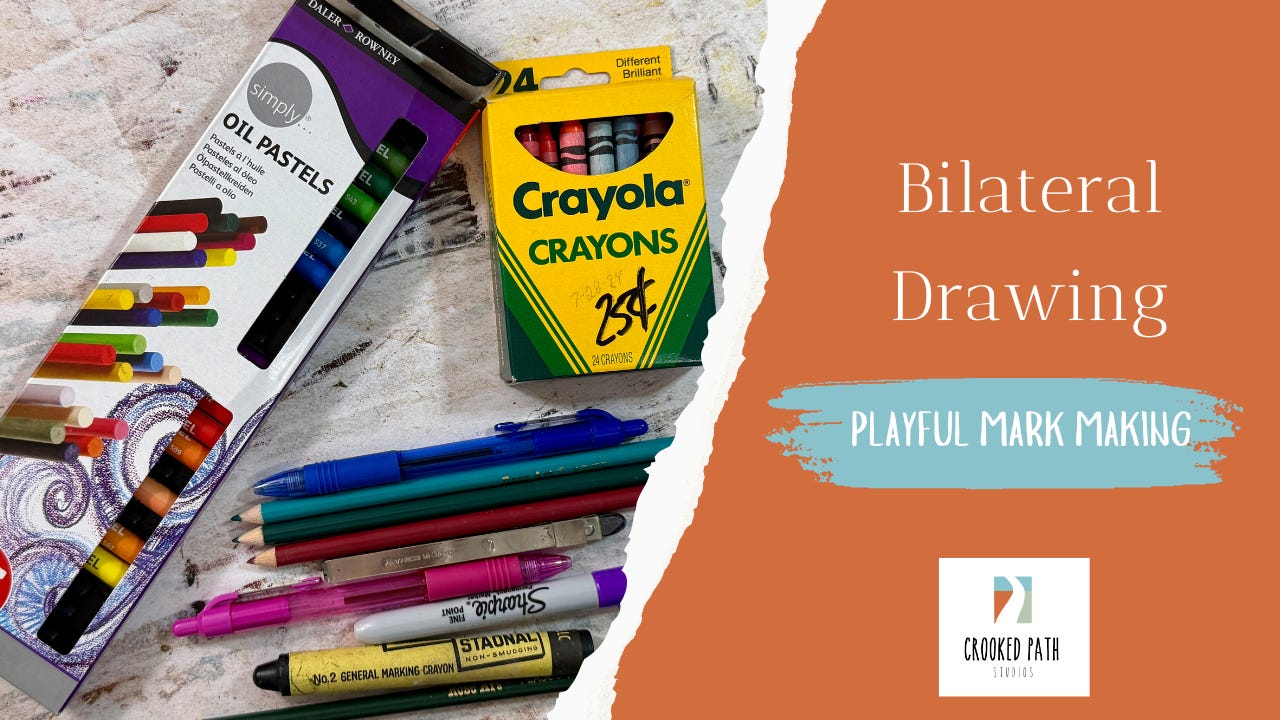
If you’re interested in how our right brain helps us express emotions, you might want to try bilateral drawing with me.
Supplies
Choose at least 1 media or surface that is new to you.
If working on a new surface (like me), gather a variety of media and tools to make marks, maybe even something to cut, poke, or scrape the surface.
If working with a new media, gather a variety of surfaces to experiment on (paper, cardboard, wood, fabric, plastic), along with other media and water to see how it plays with different elements. You can pick dry media (pencils, charcoal, pens etc.) and fluid media (paints, inks, etc.) or even clay.
As an Amazon Associate, I earn from qualifying purchases at no cost to you.
If you are taking part in the Not Buying It campaign, you can visit my Mark Making list on Blick. As a Blick Affiliate, I earn a small commission from qualifying purchases at no cost to you.
The Practice
Check-in
Before you begin: what assumptions are you walking in with today?
Not about technique. About yourself. About what you will create. Just note these. And set them aside. That’s all.
Create
This is a completely self-directed activity. If you are working with a new surface, pick a media you feel very comfortable with first and see what kinds of marks it will make on this new surface.
If you are working with a new media, maybe pick a surface you know and use well. Something familiar. Notice when things become unfamiliar.
If something feels really uncomfortable or you feel stuck, notice where that feeling sits in your body. Step back or look away for a minute. Then try a different surface or media, or crumple up the surface and then smooth it out and make some more marks.
I started with the white crayon because I like to rough up the paper first—make some marks so it is not as precious. It’s no longer a blank white (or in this case beige) paper staring back at me. And I love layers, so adding a resist bakes some layering into the process from the start.
That teabag paper became a powerful teacher—not because it worked beautifully, but because it didn’t.
When we work with materials we don’t know, or materials that unnerve us a little, our attention shifts. Unfamiliarity demands our attention. It dissolves autopilot. It interrupts the part of us that tries to control the outcome; our left-brain product-centered mind. Suddenly, we’re not thinking five steps ahead—we’re right here with the surface, the mark, and our response. We are in the moment. We are in flow.
Using an unfamiliar material snapped me out of my default settings. I couldn’t lean on experience. I had to feel my way through—brush by brush, layer by layer. I had to watch how the paper absorbed, resisted, buckled, dried. I had to respond instead of impose.
That presence—forced by discomfort—is profoundly mindful. It’s a somatic practice disguised as a creative practice.
And for those of us living with chronic illness, that kind of sensory grounding is more than a creative technique. It’s a survival strategy. Trusting the process—making friends with uncertainty—is about trusting ourselves.
It’s how we come back into our bodies after multitudes of symptoms, fear, and/or medical chaos make us not trust ourselves. It’s how we reclaim a sense of agency when so much of our lives feel interrupted or out of our control.
Working with unfamiliar materials becomes a rehearsal for uncertainty. Not a metaphorical one. A real, felt, embodied rehearsal where we practice not knowing how something will turn out and we keep going.
It’s a quiet form of rebellion: letting curiosity lead when everything in the world tells us to be predictable, perfect, and tidy.
If this post resonated with you, I appreciate you sharing it with your friends here on Substack or other social platforms. Don’t forget to restack this post!
Let’s take a moment to literally move through uncertainty at the end of this practice.
Sit or stand in a way that is comfortable for you.
Then stretch out your arms wide to the side and wrap them around yourself like a big hug. This self-hug is one way to ground ourselves when we can’t jump into our creative practice.
Last year, I needed more self-hugs. I will do more of them this year.
Crooked Path Studios is completely community supported. Here’s how you can support this practice and other women like you.
Become part of the community with full access to all upcoming workshop series, live virtual community events, group sessions and any other community events by joining at the Wayfinding tier on Substack.
If you want to support this work without a monthly subscription, join workshops a la carte, schedule a 1:1 therapeutic practice, or purchase digital art kits and downloads, then please visit my Crooked Path Studios shop by clicking the button below.
There will always be a free Unfolding Path tier for short therapeutic practices, studio reflections, and the latest on arts and health research for chronic illness.
I’d love to hear from you! Please share your work in a comment or the chat.