
Swinging the Bat
Why smashing things can be mindful

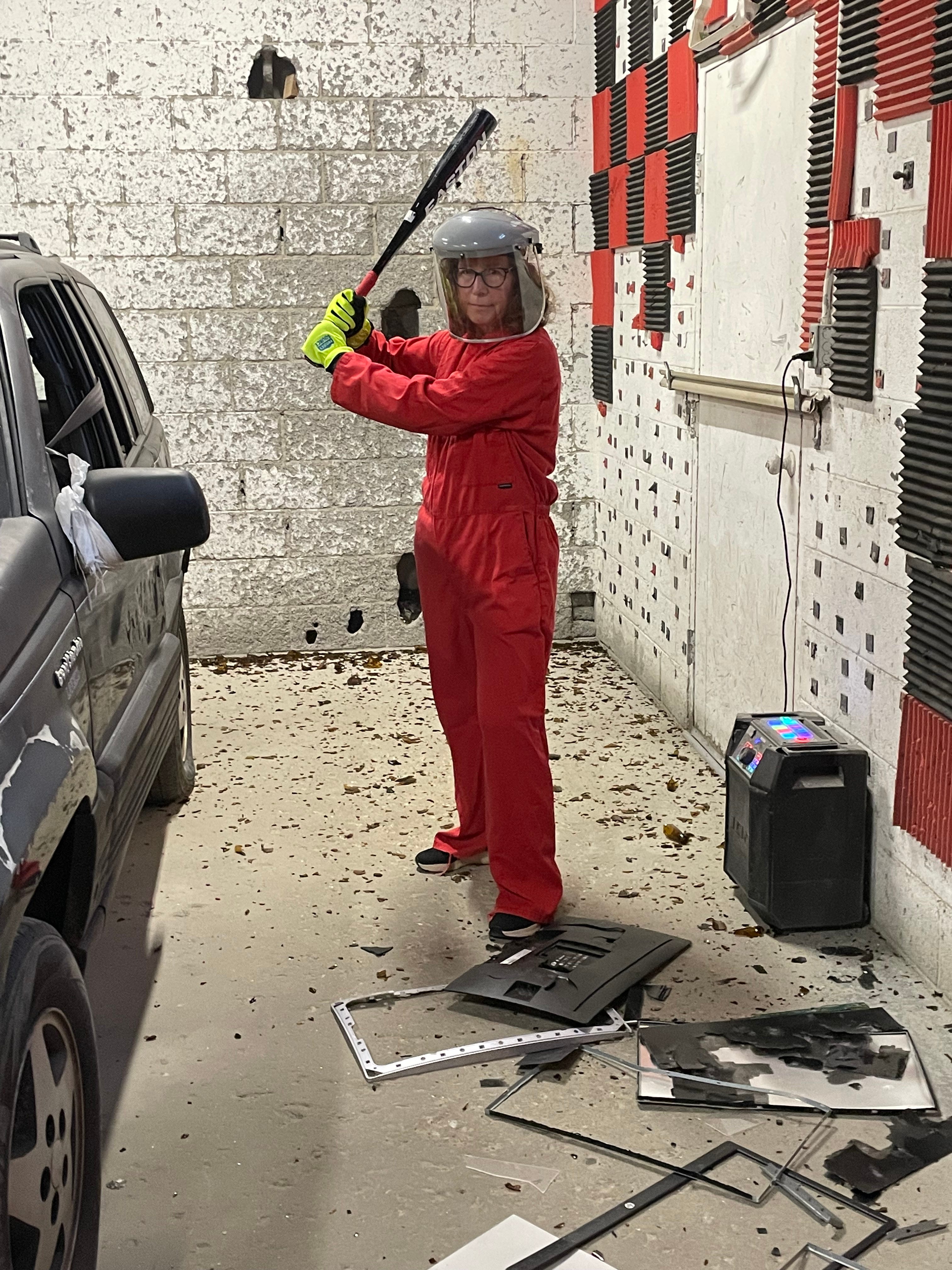
I started this year at a Rage Room in the city near me. Baseball bat in hand, surrounded by shattered glass and the echo of my own anger. And now, as the year closes, I feel the pull to return.
Starting 2025
January was all sharp edges. Early days of the new regime, the kind that tighten your chest before you even open the news. Everything felt brittle—democracy, funding, decency, civility, my own nervous system. Rage gave us a helmet, a bat, loud music, and permission. Permission to swing. Permission to break things that were already broken.
I remember the sound more than anything else. Glass doesn’t shatter delicately. It explodes. It announces itself.
Computers are harder to destroy with a bat than you’d think. They absorb the blows. You have to work for it.
I left that day lighter. Not healed. Not fixed. But emptied out enough to breathe again.
Sometimes mindfulness isn’t about stillness. Or sitting cross-legged in silence or breathing away the storm. Sometimes it’s not about calming down or finding your center or whispering affirmations into a body that does not believe you.
Sometimes mindfulness is about motion. And safely smashing things.
About finding safe, intentional ways to release what has been building inside. About giving rage a container so it doesn’t turn inward. About letting your body finish a sentence your mind doesn’t have the energy to complete.
This year brought anger, anxiety, grief, and trauma. And while body scans and meditation have their place, there were moments—many moments—when they weren’t enough. When my body needed to move. When rage needed an outlet. When smashing stuff felt like both destruction and liberation.
Ending 2025
Now it’s December. The year is ending. And I am not angry in the same way.
I am grieving.
I’m grieving the closing of a business I built after getting sick. Carefully, stubbornly, against the odds. A business that wasn’t just a business, but part of my professional identity. Part of my illness narrative. Proof that I could still think, analyze, problem-solve, make decisions. Proof I could earn a living after MCAS and Sarcoidosis rearranged my life, and I had to rewire my cognitive functioning.
That business was evidence. Evidence that wellness didn’t mean returning to who I had been before, but finding a way to work, think, and contribute differently. Evidence of the new me.
The new me returned to what I did best—program evaluation. But with a new focus. I helped nonprofits and federally funded programs assess their impact, tell better stories with data, and strengthen their work in the communities they served. It mattered. And it brought me real joy.
And now it’s gone. Not because the business failed. But because the economy shifted, programs were eliminated, funding was cut, and good work — work we had the data to prove was making a difference — became collateral damage or banned.
I’m grieving my clients, brilliant, committed organizations, losing funding and being forced to stop work that mattered deeply in their communities. I’m grieving the conversations that ended mid-sentence. The programs that will never get their second year. The people who did everything right and still lost.
I’m grieving for the animal rescue where I volunteer, where the surrender list keeps growing. Perfectly healthy, well-behaved family pets surrendered because their families can’t afford vet bills anymore. Or food. Or rent. Or the pet deposit at whatever temporary place they’re landing after losing a home.
This grief isn’t theoretical. It’s stacked up in my body like unsent letters.
And here’s the thing I don’t hear said out loud very often: I have not had the time or energy to cry about any of this.
I closed a business. I started new ones. I pivoted. I adapted. I turned 60.
And I did what I always do. What I did long before chronic illness entered the picture. I planned. I solved the problem. I panicked about earning a living, about paying a mortgage, about keeping things from collapsing.
When stress hits, I hide my illness. I pretend it isn’t there so I can push through. Rest later, solve the problem now. I know exactly how disastrous that pattern is for my physical, emotional, and mental wellbeing — and I do it anyway.
Crying requires space. Crying requires time. Crying requires a nervous system that believes it will be held.
Right now, what my body keeps saying is: move.
Not gently. Not symbolically. Physically.
My creative practice has helped immensely, yes. Art always helps. But this grief has weight. It has velocity. It wants momentum. It wants sound.
It wants a baseball bat.
Full Circle
So, we’re going back to the Rage Room. Ending the year where we began.
Not because I’m still angry, but because I understand something now that I didn’t fully understand in January. That mindfulness doesn’t always look like stillness. That grief doesn’t always look like tears. That sometimes the most honest thing you can do is give your body a task it understands and doesn’t have to think about.
Swing. Yell. Sweat. Break something that is already meant to be broken.
There is something profoundly grounding about putting on protective gear and being told, explicitly: please smash this to bits. There is no right way to grieve here. Just sound and impact and follow-through.
A baseball bat meeting a car door.
Glass breaking under the weight of everything I’ve carried.
Punk rock loud enough to drown out the voice that says, “I need to fix this.”
There is a kind of quiet that comes after impact. A pause where your breath catches up to you. Where the adrenaline fades and you realize you are still here.
That’s the quiet I’m after.
Not the kind that asks me to calm down.
The kind that arrives because I finally let myself move.
Permission Slip
If you’re ending this year heavy, angry, grieving, numb, exhausted then this is your permission slip to stop trying to process everything neatly. To stop assuming that stillness is the highest form of mindfulness. To stop believing that crying is the only legitimate expression of loss.
Sometimes the most mindful thing you can do is pick up a bat and swing.
Sometimes you need loud music.
Sometimes you need motion.
Sometimes you need a room designed to hold what you can’t.
I’ll let you know how it feels afterward.
When the glass breaks, my body finally registers the impact. Not because it was easy, but because I worked for it.
Free art tutorials, nerdy arts and health science reviews will return in 2026 plus some paid workshops.